
Complete steps flow chart for innovative idea to granted patent in India
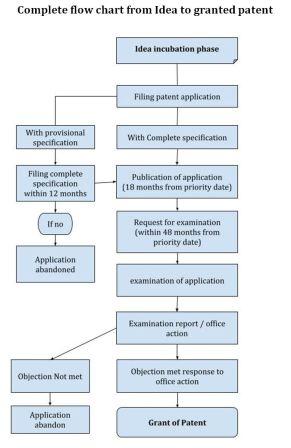
Detailed guides, articles and videos explaining every step of complete Patent Lifecycle
- From idea to invention disclosure
- Novelty search
- Patent drafting – Writing patent application
- Filing patent application
- Publication of application
- Request for examination (RFE)
- Examination of application
- Response to objections or First Examination Report
- Attenting Hearing
- Grant of patent

The Complete Flow: From an Idea to a Granted Patent in India
Most explanations of the patent process are presented as neat flow charts. In practice, the journey from an idea to a granted patent is not linear, and it is rarely neat. What looks like a sequence of boxes often involves decisions, delays, and strategic choices that are not visible in a diagram. This page explains the full flow of a patent in India as it actually unfolds, and what usually matters at each stage.
The Starting Point Is Not Filing
Every patent begins with an idea. But very few ideas are ready to be filed. At this stage, what usually exists is:
- a problem that needs solving,
- a rough solution,
- and an assumption that “this should be patentable.”
The risk here is premature filing. In our practice, applications that struggle later often do so because the idea was filed before it was converted into a clear technical disclosure.
From Idea to Invention Disclosure
The first real transition is from idea to invention. This happens when the inventor can explain:
- what the technical problem is,
- how it is solved,
- and how the solution works step by step.
This explanation does not need legal language. It needs technical clarity. A complete invention disclosure is the foundation of everything that follows. Weaknesses at this stage usually reappear during examination.
for more details, you may watch the video on what is exact information needed to file a patent application: creating complete invention disclosure
Patentability / Novelty Search (Optional, but Often Decisive)
Before drafting, many applicants choose to conduct a patentability or novelty search. This is not a legal requirement. It is a strategic one. A well-interpreted search helps identify:
- what already exists,
- where the real technical difference lies,
- and how claims should be framed.
In crowded technical fields, this step often determines whether drafting proceeds confidently or cautiously. Skipping it is sometimes reasonable. Skipping it unknowingly is not.
- Video : Patentability search or Novelty search, is it required? advantages of novelty search
- Video : How to Review a Novelty or Patentability Search Report X Y A Category prior arts
Drafting the Patent Application
Drafting is where the invention is legally defined. This stage involves:
- writing the specification,
- describing the invention in sufficient detail,
- and most importantly, drafting claims.
Claims are not summaries. They are boundaries.
Once filed, these boundaries can usually be narrowed, but rarely expanded. This is why drafting quality has long-term consequences that are not obvious at filing.
- Video : Patent Drafting – Writing Patent Application, how patent attorney work on invention
- Video: How to Review a Patent Draft (Patent application) Before Filing at the Patent Office
Filing the Patent Application
Once drafted, the application is filed with the Indian Patent Office. From this moment:
- a priority date is secured,
- the invention can be marked as “Patent Applied” or “Patent Pending,”
- and public disclosure becomes safer.
At this stage, the patent is not examined and not enforceable. But strategic value often begins here, not at grant.
- Video : What happens after Patent Filed patent pending rights and responsibilities explained
- Video : How to Choose Patent Applicant in India Individual vs Company for faster Grant
Publication of the Patent Application
By default, a patent application is published after 18 months from the filing or priority date. Early publication can be requested. Publication:
- makes the invention public,
- allows third parties to view the application,
- and starts the clock for certain future rights.
In practice, publication is where many inventors first realise how their invention appears to outsiders. detailed information at Step 3 : Publication of application
Request for Examination (RFE)
A patent application is not examined automatically. Examination begins only after a Request for Examination is filed within the prescribed time limit. This step is procedural, but missing it is fatal. Applications without an RFE simply lapse. The timing of this request often affects how quickly the application moves forward. detailed information at step 4 : Request for examination (RFE) and step 5 : Examination of application
Examination and the First Examination Report (FER)
This is where the patent office formally evaluates the application. The examiner reviews following things:
- novelty,
- inventive step,
- statutory exclusions,
- clarity and sufficiency of disclosure.
The outcome is the First Examination Report, which lists objections and requirements. In our experience, most applications receive objections. This is normal. The content and structure of those objections often reflect the quality of the original drafting.
Responding to the FER
This stage determines whether the application progresses or stalls. Responses may involve:
- legal arguments,
- technical explanations,
- and amendments to claims.
Not every objection should be answered in the same way. Some require explanation. Others require narrowing. Some indicate deeper structural issues.
Video : Patent First Examination Report FER Explained : Overcoming Objections in FER India
Hearings (If Required)
If objections are not resolved on paper, the Patent Office may schedule a hearing. Hearings are an opportunity to clarify positions, but they are rarely a place to introduce entirely new arguments. What happens here is usually shaped much earlier in the process.
Video : Patent Office Hearing in India Explained : Grant Rejection or Conditional Acceptance
Grant of Patent
If objections are overcome, the patent is granted. Grant does not mean the end of responsibility. It means the beginning of enforceable rights. From this point:
- the patent can be enforced,
- licensing becomes legally stronger,
- and the scope of protection is fixed.
The quality of the granted patent depends almost entirely on the decisions made earlier. detailed information at Step 7 : Grant of patent
Cost, procedure and timeline for patent in India
Note: steps highlighted in Brown colour are either optional step or depends on case to case and are not mandatory to happen
| Sr. | Stages for Patent (links for more details) | Professional fees | Government Fees | Time required |
| 1 | How to go from Idea to Invention disclosure? Do I need patent agent of attorney Is my invention patentable ? | – | – | – |
| 2 | Signing Non-Disclosure Agreement (NDA) | – | – | 10 minutes to sign |
| 3 | Patentability / Novelty Search (Optional step) | ₹15,000 or (USD 170) | – | 5 days |
| 4 | Drafting Complete Patent Application | ₹30,000 or (USD 350) | – | 10 – 12 days |
| 5 | Filing patent application | ₹ 3,000 or (USD 35) | ₹ 1,600 or (USD 19) | 1 – 2 days |
| 6 | Publication of patent application | – | – | After 18 months |
| 7 | Early publication (Optional step) | ₹ 2500 or (USD 30) | 1 – 2 months | |
| 8 | Request For examination (Normal Route) | ₹ 4000 or (USD 48) | 2-3 Years | |
| 9 | Request For Expedited Examination Form 18A (Woman co-applicant, MSME or Startup firm*) (Optional step) | ₹ 8000 or (USD 96) | 8 to 9 months | |
| 10 | Drafting and Filing a response to the First Examination Report (FER) | ₹15,000 or (USD 170) | – | Drafting response 7-10 days |
| 11 | Attending Hearing with Patent office In Case hearing received from patent office | ₹20,000 or (USD 250) | – | depends on the government |
| 12 | Grant of patent or refusal | – | – | Depends on the pendency at government |
| Total (mandatory + Optionals) = | (₹45,000 to ₹83,000) or (USD 500 to US 925) | ₹ 12,550 or (USD 140) |
Recommended reading:
You may receive detailed information along with videos and document attachments in your email instantly by writing your name, email, and contact number along with a single line about your requirement. Receive all information via email
Visit our Youtube channel https://www.youtube.com/@Patentattorneyworldwide

- Indian Patent Office, Govt. of India
- Patent Facilitator for Start-ups, Startup India Govt. of India
- Bachelor’s degree in Electronics and Telecommunication engineering.
- Author of multiple books on Patents and IPR including a best-selling book on “How to patent an idea in India” which has been selected as the “Memorable Business Book of 2018” by Amazon
- Books are included in the syllabus of Educational Institutions as textbook and reference book on subject of IPR and Patents
- For over 15 years, Prasad has helped protect the intellectual property rights (IPR) of more than 1800 clients, including individuals, entrepreneurs, and educational institutes. This includes patents, trademarks, designs, and copyrights.
- links to all videos - August 6, 2025