
Patent Commercialization for NIRF Ranking: How AI Can Turn Your Granted Patents into Revenue & Ranking Power
From Patent Filing to Patent Revenue: The Missing Link in Your NIRF Strategy
Filing Patents Is Not Enough Anymore
- India is witnessing record patent filings.
- Most universities proudly publish “Number of Patents Filed” in brochures.
- But NIRF does not reward filings alone.
- It evaluates commercialization, licensing, and technology transfer impact.
The Hidden Reality in Most Institutions
Let us be candid. Many institutes:
- File patents primarily for ranking visibility
- Lack structured commercialization pipelines
- Do not have dedicated Technology Transfer Offices (TTOs)
- Rely on informal industry contacts
- Have no systematic licensee discovery mechanism
As a result:
- Patents remain unexploited
- Faculty lose motivation for market-driven research
- Industry remains unaware of available technologies
- Institutional innovation ecosystem weakens
The issue is not lack of innovation. The issue is lack of commercialization infrastructure.

The Institutional Risk of Ignoring Commercialization
If patents are not commercialized:
- Your NIRF score potential remains underutilized
- Your research impact metrics stay limited
- Industry engagement remains superficial
- Innovation narrative weakens
- Return on patent investment declines
Consider the financial logic:
An institute may spend lakhs on:
- Patent drafting
- Filing fees
- Prosecution
- Maintenance
Yet without commercialization, that investment does not create revenue or measurable impact.
The New Question Institutes Must Ask. Not: “How many patents did we file this year?” But: “How many patents did we commercialize this year?” And this is precisely where AI-driven commercialization infrastructure becomes transformative. visit https://openipmarket.com/
Understanding NIRF: Why Patent Commercialization Directly Impacts Your Ranking
India’s premier ranking framework National Institutional Ranking Framework (NIRF) evaluates institutions not merely on academic activity, but on measurable outcomes. Under the parameter:
Research and Professional Practice (RP)
Institutes are assessed on:
- Patents Filed
- Patents Granted
- Patents Published
- Patents Licensed
- Revenue Generated from IP
- Revenue generated
The distinction is critical.
NIRF rewards institutions that demonstrate:
- Transfer of technology to industry
- Industry adoption of institutional research
- Revenue from intellectual property
- Tangible economic contribution
In short:
Commercialization converts academic output into national contribution.
Institutes targeting Top 100 NIRF rankings must now think beyond filing numbers. The competitive differentiator lies in technology transfer effectiveness.
The Real Problem in Most Institutes Why Patents Don’t Get Commercialized
Despite strong filing numbers, most academic patents remain underutilized.
Why?
1. No Structured Commercialization Engine
Most institutions have:
- IPR cells
- Patent committees
- Filing support systems
But lack:
- Market discovery systems
- Licensee identification databases
- Industry matchmaking infrastructure
2. Manual & Slow Outreach
Traditional process involves:
- Sending emails to companies
- Attending industry conferences
- Relying on alumni networks
- Informal faculty contacts
This process is:
- Time-consuming
- Inconsistent
- Dependent on individual effort
- Difficult to scale
3. Absence of Technology Positioning
Industry does not read patent documents.
They need:
- Commercial summaries
- Market positioning
- Application mapping
- Industry relevance framing
Without this, even strong patents remain invisible.
The Result:
- 80–90% academic patents remain unlicensed
- No revenue generation
- No industry traction
- No measurable commercialization data for NIRF
The gap is not innovation.
The gap is execution.
Introducing AI-Based Patent Commercialization Engine
OpenIPMarket – AI Powered Patent Commercialization Platform

Core Promise:
“Start Commercializing Your Patent in Minutes, Not Months, With the Power of AI.”
What It Does:
- AI analyzes your patent
- Identifies industry relevance
- Maps potential buyers/licensees
- Creates commercialization-ready presentation
- Lists patent on global marketplace
- Enables direct licensing conversations
What the AI Engine Does
1. Patent Analysis
AI studies your patent abstract and claims to understand:
- Technical domain
- Application areas
- Industry alignment
- Commercial potential
2. Industry Mapping
The system identifies:
- Relevant industrial sectors
- Potential buyer profiles
- Licensing opportunity categories
3. Structured Commercial Listing
Instead of uploading raw patent PDFs, the platform helps create:
- Commercially structured summaries
- Industry-friendly descriptions
- Application-focused positioning
4. Global Marketplace Exposure
Your patent becomes discoverable by:
- Corporates
- Start-ups
- Investors
- Technology scouts
- R&D divisions
This dramatically increases visibility beyond local networks.
How It Directly Improves NIRF Ranking
Direct Impact Areas
| NIRF Component | How AI Commercialization Helps |
|---|---|
| Patents Licensed | Structured exposure to industry |
| Revenue from IP | Enables licensing deals |
| Industry Perception | Visible innovation ecosystem |
| Research Impact | Practical application of research |
| Consultancy & Projects | Leads to industry collaboration |
Instead of filing 100 unused patents, commercialize 10 strategically and multiply your NIRF score impact.
Traditional vs AI Commercialization Approach
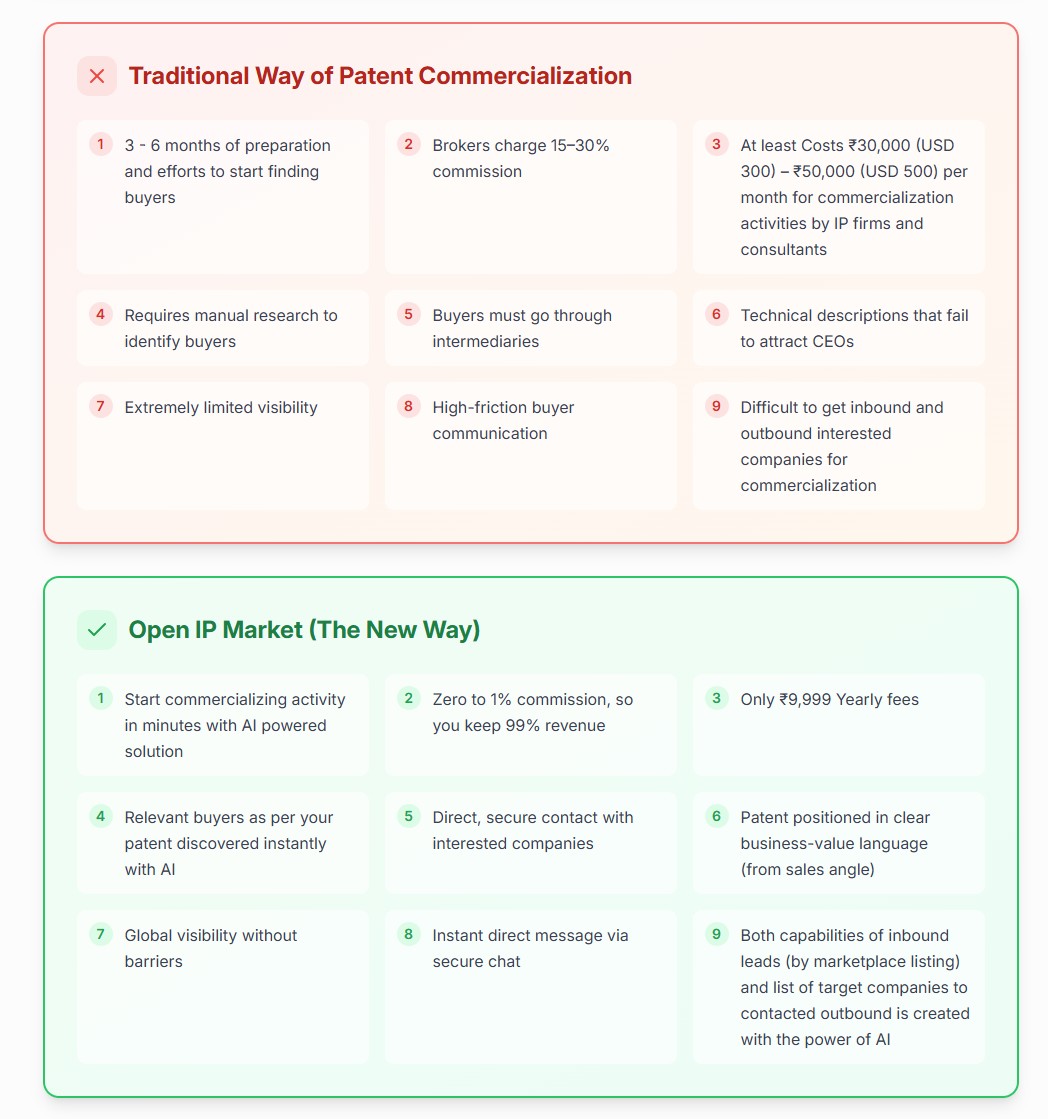
Traditional Model:
- Manual emails
- Networking events
- Cold industry outreach
- 6–18 months cycle
- Uncertain results
AI Model (OpenIPMarket): https://openipmarket.com
- Automated industry mapping
- Instant market visibility
- Smart categorization
- Global buyer exposure
- Continuous digital presence
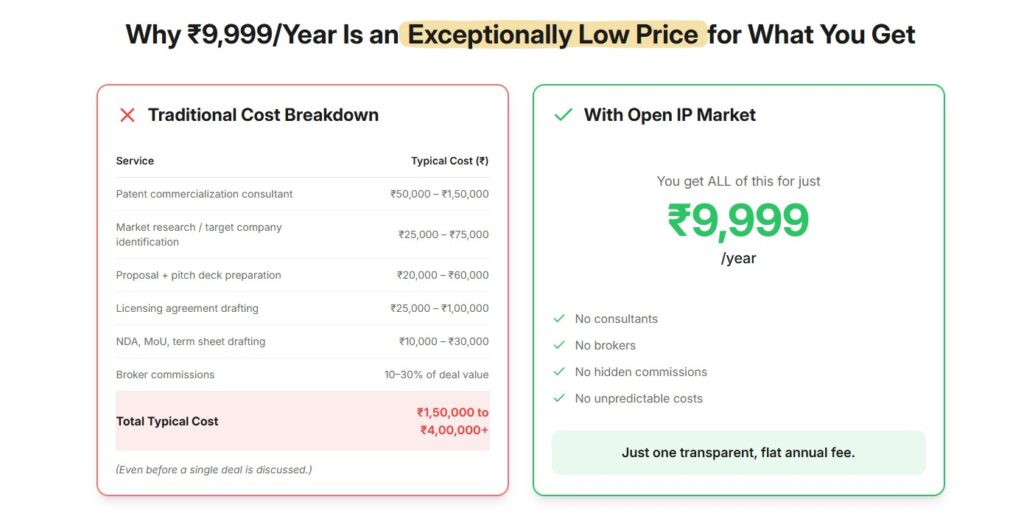
Cost Analysis ₹ 9,999 per patent per year
You spend lakhs to create the asset. Why not spend ₹9,999 to monetize it?
8️⃣ ROI Calculation Example for College
Example: If institute lists:
20 patents × ₹9,999 = ₹1,99,980 per year
Even 1 licensing deal worth ₹5–10 lakhs recovers cost.
If 2–3 patents licensed:
- Generates recurring revenue
- Improves NIRF score
- Strengthens annual report metrics
Strategic Benefits for Institutes and colleges
1. Strengthens Innovation Ecosystem
- Encourages faculty to file quality patents
- Moves from filing culture → commercialization culture
2. Improves Industry Collaboration
- Industry discovers institute expertise
3. Attracts Funding
- CSR partnerships
- Industry R&D contracts
4. Enhances Student Entrepreneurship
- Spin-offs
- Start-up incubation
Positions Institute as Industry-Ready Research Hub
For Whom Is This Ideal?
- Engineering Colleges
- Pharmacy Colleges
- Biotechnology Institutes
- Agricultural Universities
- Autonomous Universities
- NAAC A/A+ institutes
- Institutions targeting Top 100 NIRF
Comparison: Filing-Centric vs Commercialization-Centric Institute
| Filing Focused | Commercialization Focused |
|---|---|
| Academic recognition | Industry recognition |
| Static IP portfolio | Revenue generating IP |
| Brochure data | NIRF impact data |
| Annual patent count | Licensing & revenue metrics |
“From Patent Filing Institute to Innovation Powerhouse”
Explain transformation:
- Research → Patent → AI Mapping → Industry → Licensing → Revenue → NIRF Boost
If Your Institute Has Filed Patents, The Next Logical Step Is Commercialization.
- Don’t let patents sit idle.
- Don’t let NIRF points slip away.
- Don’t let industry stay unaware.
Start Commercializing Your Patent in Minutes Not Months.
At Just ₹9,999 Per Patent Per Year.
Transform your innovation output into measurable institutional impact.
The Institutions That Move First Will Lead
Five years from now, rankings will reflect:
- Industry integration
- Commercialization maturity
- Revenue from IP
- Translational research impact
The institutions that act today will dominate tomorrow. The institutions that delay will continue filing but not monetizing.
The Real Question Is Not “Should We?”
The real question is:
How much longer can we afford to let our patents sit idle?
You have already built the asset. Now activate it.
Start Commercializing Your Patent in Minutes Not Months.
At just ₹9,999 per patent per year.
Low risk.
High leverage.
Direct NIRF impact.
Revenue potential.
Strategic positioning.
Do not let your intellectual property remain intellectual paperwork. Turn it into institutional power.
Start Commercializing Your Patent in Minutes Not Months.
At Just ₹9,999 Per Patent Per Year.
visit https://openipmarket.com

- Indian Patent Office, Govt. of India
- Patent Facilitator for Start-ups, Startup India Govt. of India
- Bachelor’s degree in Electronics and Telecommunication engineering.
- Author of multiple books on Patents and IPR including a best-selling book on “How to patent an idea in India” which has been selected as the “Memorable Business Book of 2018” by Amazon
- Books are included in the syllabus of Educational Institutions as textbook and reference book on subject of IPR and Patents
- For over 15 years, Prasad has helped protect the intellectual property rights (IPR) of more than 1800 clients, including individuals, entrepreneurs, and educational institutes. This includes patents, trademarks, designs, and copyrights.
- links to all videos - August 6, 2025