
Patent cooperation treaty (PCT) application
Patents are territorial. that means if you have patent for your invention in India you cannot stop someone from making using selling offering for sale or importing your patented invention in some other country, that is other than India.
If you are looking for filing PCT national phase application in India refer our detailed article : link here
Obviously, you may want to protect your invention in as many countries as possible.
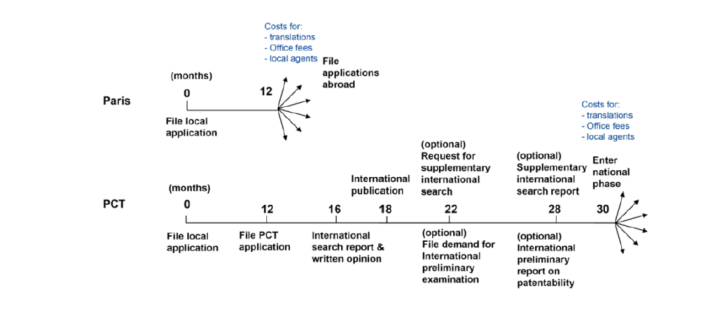
To protect your invention internationally there are 3 ways:
- File patent application directly outside India (through Convention or Patent Cooperation Treaty (PCT) route) without filing a patent application in India. You need to take a Foreign Filing License (FFL) if you choose this route.
- File patent application in India, and within 12 months of the priority date file Convention Applications in countries of your interest.
- File PCT application within 12 months of the priority date.

If you go by the conventional way (that is by Paris convention) you need to file patent applications in all countries of your interest within 12 months from the date of filing of patent application in your home country. The Paris Convention is an international treaty that allows applicants to file the first application in their home country. And within 12 months period, further application called a Paris Convention application could be filed at desired countries.
For example, you selected 10 countries to file your patent application, can you imagine the simultaneous workload? doing all the steps in all the countries of your interest like replying to objections, request for examinations, translating your patent application into different languages and ultimately professional charges of patent agents and attorneys involved at different patent offices… and all this happening simultaneously !!!
this is what would happen if you take the convention route for international filing of your patent application. to avoid such chaotic condition expenses and additional workload patent cooperation treaty created.
“PCT is administered by World Intellectual Property Organization WIPO, and its primary objective is to provide a system where you need to make only one patent application which would be searched by at least one International search authority and examined by at least one selected International Preliminary Examination Authority IPEA”
It is important to remember that pct does not provide the grant of patent it only facilitates a single application that would be taken from searching to the examination stage centrally and which would be applicable for all the signatory countries in pct. Currently, the number of countries associated with PCT are 157.
when you file an International patent application to PCT Unlike the convention application, your international patent application is valid for all 157 member countries of PCT (that is up to the international phase) and here you have about 30 to 31 months of time to decide whether to enter into the national phase of the country of the interest. This decision depends on the international search and examination report. India joined pct membership on the 7th of December 1998.
Video : How to Choose Patent Applicant in India Individual vs Company for faster Grant
Advantages of PCT for International Patent application
advantages of pct application over Paris convention:
- The pct provides the most effective and most economic way of filing a patent application in multiple countries
- It enables the application to file a single patent application with a single patent office in a single language having an effect in each country which is signatory with PCT
- The application is searched by international search authority
- It provides a formal examination of the international application by an international preliminary examination authority
- centralized International Publication of international patent application
- reduced load on patent officers by taking international patent application through searching and examination before entering into the national phase
The international phase is the phase during which the international patent application is published, search, and examined before entry in the designated country (that is national phase)
The national phase is the phase when the International patent application enters in the countries of interest. The international patent application is searched and examined by National patent offices and its granted or rejected
If you are looking for filing PCT national phase application in India refer our detailed article : link here
If you have PCT application requirement, we can discuss it over a short call and see if it has any potential to move further.
Patent Drafting Fees for India-Only vs International (foreign)
₹ 30,000 Patent Drafting professional fees for Indian Filing Only
This discounted fee applies only if you plan to file your patent exclusively in India.
It covers drafting as per Indian Patent Office requirements and is ideal for:
- Individual inventors or startups focusing only on India
- Academic or research institutions with local protection needs
However, this version is limited to Indian standards. If you later decide to expand protection internationally (via PCT or convention routes), the application would require restructuring or re-drafting, leading to additional costs and time.
₹50,000 Same Patent application can be filed in India + International (Foreign countries) (Recommended)
Our standard drafting fee of ₹ 50,000 includes a globally compliant patent specification, prepared to meet the formal and legal requirements of major patent offices — such as the USPTO (USA), EPO (Europe), JPO (Japan), and others, in addition to India.
This comprehensive draft:
- Can be filed in any number of countries without paying drafting fees again
- Is designed to meet international patent laws and claim standards
- Ensures smooth filing through PCT or convention routes
- Adds value for investors, licensees, and global partners
The ₹50,000 global-ready draft is a future-proof investment — ensuring that your patent can easily be extended worldwide whenever you decide to expand.
Why Choose India + International protection for Your invention ?
A patent once drafted properly can be used globally without rework. Paying only ₹20,000 more today saves substantial cost, time, and effort later — while securing stronger protection and higher commercial value.

Patent drafting how patent agent/attorney does it
You may be surprised to know, that patent drafting does not begin with the title of the invention or the abstract; In fact most patent attorneys/agents first draft claims !!!
Claims are the most important part of the patent application.
- Claims decide the boundaries of the protection that you would be getting for your invention
- Claims are used to enforce your patent
- Claims decide whether the competitor is infringing on your patent
- Claim are closely examined in the patent examination phase at patent office
- Claims are most difficult part of patent application to write
Of course, there are other dependencies and rules for other parts of patent applications when deciding scope but it is the claim which stands most important thing that decides the future of your patent.
Important things about claims:
Going too broad or too narrow protection while writing claims would be a mistake.
“Claims should not be too broad because those would be anticipated by existing prior arts, and the claims should not be too narrow because competitors would not be able to work around and use our invention”
The purpose of the claim is to define the invention protected by the patent.
The reason patent agent or attorney starts with writing claims first, because once we have a complete set of claims providing appropriate protection to the invention and which are approved by you (inventor), then writing remaining parts of the patent application like: detailed description, abstract and summary becomes easier as these parts generally follow the boundaries set by claims.
- Since claims define the scope of legal protection, it is suggested that they should be drafted carefully to cover all the aspects of the protection being sought at the same time adequately distinguishing the prior art from the claimed invention.
- Unity of invention and clarity of claims
- a) Claim(s) of a Complete Specification shall relate to a single invention, or to a group of inventions linked so as to form a single inventive concept.
- b) Claims shall be clear and succinct and fairly based on the matter disclosed in the specification.
- Significance of Claims
- a) A claim is a statement of technical facts expressed in legal terms defining the scope of the invention sought to be protected. No exclusivity is obtained for any matter described in the Complete Specification unless it is claimed in the claim
What is not claimed in the claims stands disclaimed, and is open to public use, even if the matter is disclosed in the description.
Each claim is evaluated on its own merit and, therefore, if one of the claims is objected, it does not mean that the rest of the claims are invalid. It is therefore important to make claims on all aspects of the invention to ensure that the applicant gets the widest possible protection.
And there are many rules and standard practices that a professional would be incorporating while writing claims for your patent application. In short,
“Claims should be written in such a way that they would not be invalidated in the litigation phase and they would not allow competitors to practice the invention without infringing on patented invention”
Just like claims, there are many rules and standards for writing other elements of patent specification like:
- A detailed description of the invention
- Diagrams, illustrations and images
- Abstract
- Field of invention
- Background of the invention
- Include references to cite
- Title of the invention
- disclosing best mode
- covering all possible embodiments
and many more…

- Indian Patent Office, Govt. of India
- Patent Facilitator for Start-ups, Startup India Govt. of India
- Bachelor’s degree in Electronics and Telecommunication engineering.
- Author of multiple books on Patents and IPR including a best-selling book on “How to patent an idea in India” which has been selected as the “Memorable Business Book of 2018” by Amazon
- Books are included in the syllabus of Educational Institutions as textbook and reference book on subject of IPR and Patents
- For over 15 years, Prasad has helped protect the intellectual property rights (IPR) of more than 1800 clients, including individuals, entrepreneurs, and educational institutes. This includes patents, trademarks, designs, and copyrights.
- links to all videos - August 6, 2025