
Micro Entity Status for USA Patent Filing USPTO Criteria, Benefits, Costs & Eligibility
When filing a patent application in the United States before the United States Patent and Trademark Office, applicants may qualify for significant reductions in official government fees under the Micro Entity Status category.
For startups, individual inventors, researchers, professors, and early-stage companies, this status can substantially reduce patent filing costs while obtaining the same legal protection available to larger corporations.
This article explains:
- What is Micro Entity Status
- USPTO eligibility criteria
- Difference between Large, Small, and Micro Entity
- Fee reductions available
- Who qualifies
- Common mistakes to avoid
- Important compliance considerations
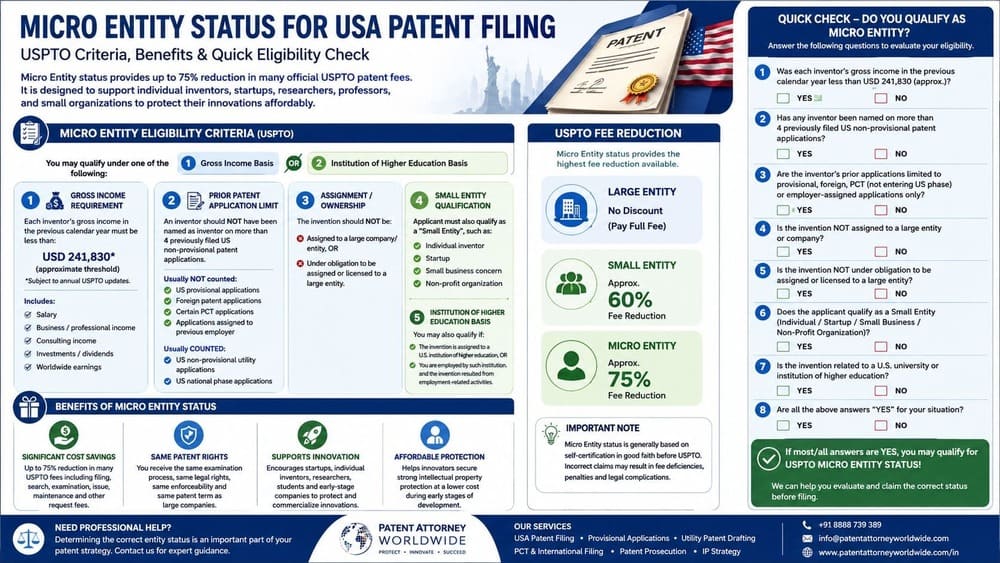
What is Micro Entity Status?
A Micro Entity is a special fee status recognized by the USPTO that allows eligible applicants to receive up to 75% reduction in many official patent fees.
The Micro Entity category was introduced to encourage:
- Innovation
- Startup ecosystem growth
- Academic research commercialization
- Independent inventors
- Affordable patent protection
Micro Entity status is especially useful for:
- Startups
- First-time inventors
- Students
- Professors
- Small businesses
- Researchers
- Early-stage technology companies
Types of USPTO Entity Status
The USPTO generally recognizes three categories:
| Entity Type | Fee Reduction |
|---|---|
| Large Entity | No discount |
| Small Entity | Approx. 60% reduction |
| Micro Entity | Approx. 75% reduction |
Micro Entity status provides the highest official fee reduction available at the USPTO.
Micro Entity Eligibility Criteria – USPTO
An applicant may qualify under either:
- Gross Income Basis
- Institution of Higher Education Basis
Most inventors qualify under the Gross Income Basis.
1. Micro Entity Eligibility – Gross Income Basis
To qualify, ALL of the following conditions must be satisfied.
A. Applicant Must First Qualify as Small Entity
Before claiming Micro Entity status, the applicant must first qualify as a Small Entity.
Typically this includes:
- Individual inventors
- Small businesses
- Non-profit organizations
Additionally:
- Patent rights must not be assigned to a large company
- Applicant must not be obligated to assign the invention to a large entity
If rights are transferred to a large corporation, Micro Entity status may no longer apply.
B. Gross Income Requirement
Each inventor/applicant must have a gross income less than:
“Three times the median household income”
The income threshold is updated annually by the USPTO.
In recent years, this limit has generally been approximately:
- USD 240,000 to USD 260,000 annually
The income calculation may include:
- Salary
- Professional income
- Consulting income
- Business profits
- Investment income
- Worldwide earnings
It is important to evaluate all applicable income sources before claiming Micro Entity status.
C. Prior Patent Filing Limitation
The inventor must NOT have been named as an inventor on more than:
Four previously filed U.S. non-provisional patent applications
This is one of the most important eligibility requirements.
Applications that generally DO NOT count:
- Provisional patent applications
- Foreign patent applications
- International PCT applications (unless entering U.S. national phase)
- Applications assigned to previous employers due to employment obligations
Applications that generally DO count:
- U.S. non-provisional utility patent applications
- U.S. national phase applications
Proper analysis of prior filings is essential before claiming Micro Entity status.
D. No Assignment to Large Entity
The applicant must not:
- Assign rights to a large company
- License rights to a non-small entity
- Be legally obligated to transfer ownership to a large entity
If the invention is funded or controlled by a large organization, eligibility should be carefully reviewed.
2. Micro Entity – Institution of Higher Education Basis
Applicants may also qualify under this category if:
- The invention is assigned to a U.S. institution of higher education, OR
- The inventor is employed by such institution and invention resulted from employment-related research activities
This category is particularly useful for:
- Universities
- Professors
- Academic researchers
- Research institutions
Benefits of Micro Entity Status
1. Significant Cost Reduction
The biggest advantage is substantial reduction in USPTO official fees.
This may apply to:
- Patent filing fees
- Search fees
- Examination fees
- Issue fees
- Maintenance fees
- Extension fees
For startups and individual inventors, these savings can be substantial over the lifetime of a patent.
2. Affordable Patent Protection
Micro Entity status helps:
- Early-stage startups
- Independent inventors
- Student innovators
- Researchers
obtain patent protection at a lower cost.
This encourages innovation and technology commercialization.
3. Same Patent Rights as Large Companies
A Micro Entity patent application receives:
- Same examination process
- Same legal rights
- Same enforceability
- Same patent term
The fee discount does not reduce the strength or validity of the patent.
Common Examples of Eligible Applicants
The following applicants often qualify:
- First-time inventors
- Individual entrepreneurs
- Startup founders
- Professors
- Researchers
- Students
- Small technology companies
- Independent engineers and developers
Common Examples of Non-Eligible Applicants
Applicants may NOT qualify if:
- Income exceeds USPTO threshold
- More than four prior U.S. non-provisional filings exist
- Patent assigned to large corporation
- Applicant works under mandatory assignment agreement with large company
- Company no longer qualifies as Small Entity
Important Compliance Considerations
Micro Entity status is generally based on:
Self-certification
Applicants certify eligibility in good faith while filing.
However, incorrect claims may lead to:
- Fee deficiency notices
- Requirement to pay balance fees
- Penalties
- Legal complications
- Patent enforceability concerns in serious cases
Therefore, eligibility should always be verified carefully before filing.
Can Micro Entity Status Change Later?
Yes.
An applicant may initially qualify as Micro Entity but later lose eligibility due to:
- Increase in income
- Additional patent filings
- Assignment to large entity
- Investment or acquisition by larger company
In such situations, future USPTO payments must be made under the correct entity status.
Micro Entity Status for Startups
Many startups initially qualify as Micro Entity during early stages.
However, founders should carefully evaluate:
- Shareholding structure
- Investment agreements
- IP assignment clauses
- Licensing agreements
- Funding arrangements
before claiming Micro Entity status.
Professional Assistance for USPTO Patent Filing
Determining proper USPTO entity status is an important part of patent filing strategy.
Incorrect classification may create procedural and legal complications later.
At Patent Attorney Worldwide Private Limited, we assist inventors, startups, researchers, and companies with:
- USA patent filing
- USPTO Micro Entity assessment
- Provisional patent applications
- Utility patent drafting
- International patent filing
- PCT applications
- Patent strategy and prosecution
Conclusion
USPTO Micro Entity Status offers an excellent opportunity for startups, researchers, and individual inventors to obtain patent protection in the United States at significantly reduced official costs.
Applicants must carefully evaluate:
- Income limits
- Prior patent filings
- Ownership structure
- Assignment obligations
before claiming Micro Entity status.
When properly used, this category can help innovators secure strong intellectual property protection while minimizing filing expenses during the early stages of innovation and commercialization.
Official USPTO Resource: USPTO Micro Entity Status Guidelines

- Indian Patent Office, Govt. of India
- Patent Facilitator for Start-ups, Startup India Govt. of India
- Bachelor’s degree in Electronics and Telecommunication engineering.
- Author of multiple books on Patents and IPR including a best-selling book on “How to patent an idea in India” which has been selected as the “Memorable Business Book of 2018” by Amazon
- Books are included in the syllabus of Educational Institutions as textbook and reference book on subject of IPR and Patents
- For over 15 years, Prasad has helped protect the intellectual property rights (IPR) of more than 1800 clients, including individuals, entrepreneurs, and educational institutes. This includes patents, trademarks, designs, and copyrights.