
Patent Cooperation Treaty (PCT) Application: Comprehensive Guide Starting from USPTO Costs and Procedures
A PCT (Patent Cooperation Treaty) application is an international patent application filed under the treaty. It enables simultaneous patent protection in multiple countries through a single application, delaying the need for individual national filings. It offers a centralized system, giving applicants extra time to choose countries for patent protection.
Patents are territorial. which means if you have a patent for your invention in the United States (US) you cannot stop someone from making using selling offering for sale or importing your patented invention in some other country, that is other than US.

The Patent Cooperation Treaty (PCT) represents one of the most significant international agreements in intellectual property law, providing inventors and companies with a streamlined pathway to seek patent protection across multiple jurisdictions. As a treaty administered by the World Intellectual Property Organization (WIPO), the PCT enables applicants to file a single international application that can subsequently lead to patent protection in over 150 member countries.
Understanding the PCT System
The PCT does not itself grant patents but rather provides a unified procedure for filing patent applications internationally. The system operates on a two-phase structure: an international phase managed by WIPO and various international authorities, followed by national or regional phases in individual countries where actual patent grants occur.
Key Features of the PCT
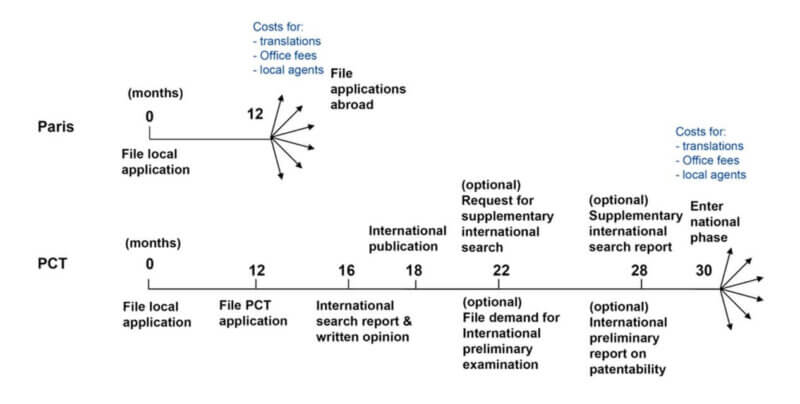
The PCT system offers several fundamental advantages. First, it provides applicants with up to 30 or 31 months from the priority date to decide which countries they want to pursue patent protection in, compared to the standard 12-month period under the Paris Convention. This extended timeline allows inventors to assess market potential, secure funding, and make informed decisions about where to invest in patent prosecution.
Second, the PCT provides an International Search Report (ISR) and Written Opinion that offers valuable insights into the patentability of an invention before committing to expensive national filings. This early assessment helps applicants understand potential challenges and refine their strategies accordingly.
USPTO PCT Filing Costs (2025)
The USPTO implemented significant fee increases effective January 19, 2025, affecting various aspects of PCT filing and prosecution. Understanding these costs is crucial for budgeting and strategic planning.
International Phase Fees
When filing a PCT application through the USPTO as the receiving office, applicants must pay several fees:
- Transmittal Fee: $285 for large entities, $114 for small entities, and $57 for micro entities
- International Filing Fee: $1,456 for all entity sizes, with an additional handling fee of $219
- Search Fee: $2,400 for large entities, $960 for small entities, and $480 for micro entities when the USPTO serves as the International Searching Authority
For a typical large entity filing electronically with the USPTO as both receiving office and International Searching Authority, the total international phase costs would be approximately $4,141 ($285 + $1,456 + $219 + $2,400).
PCT Fees for Micro Entity – Comprehensive Breakdown
This table provides a complete overview of all PCT-related fees for micro entities as of September 2025, including both international phase and US national phase costs.
Key Highlights for Micro Entity Applicants
International Phase Costs (Most Common Scenario)
For a typical micro entity filing a PCT application electronically with ePCT format, using USPTO as the International Searching Authority:
- Transmittal Fee: $57 (80% reduction from $285 large entity fee)
- International Filing Fee: $1,362 (same for all entities when filed with ePCT)
- Search Fee (USPTO as ISA): $480 (80% reduction from $2,400 large entity fee)
Total International Phase Cost: $1,899
National Phase Entry Costs
The costs escalate significantly during national phase entry. For USPTO national phase entry from a PCT application, applicants face:
- Basic national fee variations by entity size
- Translation costs where applicable
- Local attorney fees typically ranging from $2,000 to $5,000 per jurisdiction
- Ongoing examination and maintenance fees
Fee Reductions and Considerations
The PCT system offers substantial fee reductions for qualifying applicants. Small entities receive 60% reductions on most fees, while micro entities receive 80% reductions. Additionally, certain developing countries may qualify for 90% reductions in international filing fees under specific circumstances.
PCT Filing Procedure
Step 1: Eligibility and Receiving Office Selection
The first crucial step involves determining eligibility and selecting an appropriate receiving office. To file a PCT application with the USPTO as the receiving office, at least one applicant must be a U.S. national or resident. If no applicant meets this requirement, the application must be filed with another competent receiving office or with the International Bureau of WIPO.
For U.S.-made inventions owned by foreign applicants, special considerations apply. A foreign filing license must typically be obtained before filing a PCT application abroad. The common solution involves first filing a U.S. provisional or nonprovisional application to obtain the necessary foreign filing license.
Step 2: Preparing Required Documents
A complete PCT application must include several mandatory documents:
Request Form (PCT/RO/101): This standardized form serves as the foundation of the application and must include:
- Petition for PCT processing
- Designation of at least one contracting state
- Complete applicant and inventor information
- Title of the invention
- Priority claims (if applicable)
- Required signatures
Description: A comprehensive technical disclosure explaining the invention, its background, and how it works
Claims: One or more claims defining the scope of protection sought
Abstract: A brief technical summary not exceeding 150 words
Drawings: Required when necessary for understanding the invention
Step 3: Language and Format Requirements
PCT applications must be filed in a language accepted by the receiving office. The USPTO accepts applications in English. All documents must comply with specific physical requirements, including paper size (A4), margins, font specifications, and formatting standards.
Step 4: Electronic Filing Process
The USPTO strongly encourages electronic filing through its EFS-Web system or WIPO’s ePCT platform. Electronic filing offers several advantages:
- Reduced filing fees
- Faster processing
- Immediate confirmation of receipt
- Built-in validation features
Step 5: Fee Payment
All required fees must be paid upon filing or within prescribed time limits. The USPTO accepts various payment methods and provides automatic fee calculation through its electronic filing systems.
International Phase Procedures
Chapter I: Default Route
By default, every PCT application proceeds under Chapter I, which includes:
International Search: Conducted by an International Searching Authority (ISA) within approximately 16 months from the priority date, producing an International Search Report and Written Opinion
International Publication: The application is published 18 months after the priority date, making the invention publicly available
Optional Article 19 Amendments: Applicants may file claim amendments in response to the search report, typically within 2 months of receiving the ISR or 16 months from the priority date, whichever is later
Chapter II: Enhanced Examination Route
Applicants may optionally file a Demand for International Preliminary Examination, triggering Chapter II proceedings:
Interactive Examination: Unlike Chapter I, Chapter II allows dialogue between the applicant and examiner, providing opportunities to address objections and submit amendments
International Preliminary Report on Patentability (IPRP Chapter II): This detailed report provides a more thorough patentability assessment and often carries significant weight with national offices
Strategic Considerations: Chapter II is particularly valuable when the initial search report is negative, allowing applicants to strengthen their position before national phase entry
National Phase Entry Requirements
Timeline and Deadlines
Most PCT contracting states require national phase entry within 30 months from the priority date, though some countries allow 31 months. These deadlines are absolute and cannot be extended in most jurisdictions.
Entry Requirements
National phase entry typically requires:
- Translation of the application into the national language (where required)
- Payment of national filing fees
- Appointment of local counsel
- Compliance with specific national requirements
- Filing of required forms and declarations
Strategic Considerations for National Phase
The decision of which countries to enter requires careful analysis of:
- Market potential and commercial viability
- Competitive landscape
- Enforcement capabilities
- Cost-benefit analysis of patent prosecution and maintenance
- Manufacturing and distribution plans
Benefits of the PCT System
Cost and Time Advantages
The PCT system provides significant advantages over direct national filing:
- Deferred Costs: Major expenses are postponed by up to 30 months, allowing time for revenue generation and funding acquisition
- Streamlined Process: A single international application replaces multiple national filings, reducing administrative burden
- Early Patentability Assessment: The international search report provides valuable insights before committing to expensive national prosecutions
Strategic Benefits
- Market Research Time: The extended timeline allows comprehensive market analysis and business development
- Flexible Decision Making: Applicants can adjust their filing strategy based on business developments, market response, and funding availability
- Unified Prior Art Search: The international search provides a comprehensive prior art analysis across multiple jurisdictions
Limitations and Considerations
Cost Considerations
While the PCT defers costs, it may result in higher total expenses compared to direct filing in a limited number of countries:
- Additional PCT Fees: The international phase adds approximately $4,000-$6,000 to the total cost
- Cumulative Expenses: National phase costs are additional to PCT fees, not substitutes
- Attorney Fees: International phase prosecution requires specialized expertise, adding to professional service costs
Strategic Recommendations : When to Use the PCT
The PCT route is particularly advantageous for:
- Inventions with broad commercial potential across multiple markets
- Startups and SMEs needing time to secure funding and assess market viability
- Complex technologies requiring extensive market research
- Situations where the exact target markets are not yet determined
When to Consider Direct Filing
Direct national filing may be preferable for:
- Inventions targeting only a few specific countries
- Time-sensitive technologies requiring rapid patent protection
- Well-funded applicants with clear market strategies
- Jurisdictions where PCT benefits are limited
Best Practices for international Patent filing
- Early Planning: Begin PCT strategy development well before the 12-month priority deadline
- Professional Guidance: Engage experienced PCT practitioners familiar with international filing requirements and strategies
- Market Analysis: Conduct thorough market research during the PCT phase to inform national phase decisions
- Budget Planning: Develop comprehensive budgets accounting for both international phase and national phase costs
The PCT system represents a sophisticated tool for international patent protection, offering significant advantages when used strategically. While costs have increased substantially with the 2025 USPTO fee adjustments, the PCT continues to provide valuable benefits for inventors and companies seeking global patent protection. Success with the PCT requires careful planning, thorough understanding of procedures and costs, and strategic decision-making throughout both international and national phases.
The key to maximizing PCT benefits lies in understanding its role as part of a broader intellectual property strategy rather than simply a filing mechanism. When properly utilized, the PCT can provide the time, information, and flexibility needed to build strong, cost-effective international patent portfolios that support long-term business objectives.
If you go by the convention route (that is by the Paris convention) you need to file patent applications in all countries of your interest within 12 months from the date of filing of patent application in your home country.
The Paris Convention is an international treaty that allows applicants to file the first application in their home country. And within 12 months period, a further application called a Paris Convention application could be filed at desired countries.
The Patent Cooperation Treaty (PCT) is an international treaty with about 158 Contracting States. The granting of patents remains under the control of the national or regional patent offices in what is called the “national phase”.
“PCT is administered by World Intellectual Property Organization WIPO, and it’s primary objective is to provide a system where you need to make only one patent application which would be searched by at least one International search authority and examined by at least one selected International Preliminary Examination Authority IPEA”
It is important to remember that pct does not provide the grant of patent it only facilitates a single application which would be taken from searching to examination stage centrally and which would be applicable for all the signatory countries in pct. Currently, the number of countries associated with PCT are 158.
The procedure for PCT filing
- Filing: you file an international application with a national or regional patent Office or WIPO, complying with the PCT formality requirements, in one language, and you pay one set of fees.
- International Search: an “International Searching Authority” (ISA) (one of the world’s major patent Offices) identifies the published patent documents and technical literature (“prior art”) which may have an influence on whether your invention is patentable, and establishes a written opinion on your invention’s potential patentability.
- International Publication: as soon as possible after the expiration of 18 months from the earliest filing date, the content of your international application is disclosed to the world.
- Supplementary International Search (optional): a second ISA identifies, at your request, published documents that may not have been found by the first ISA which carried out the main search because of the diversity of prior art in different languages and different technical fields.
- International Preliminary Examination (optional): one of the ISAs at your request, carries out an additional patentability analysis, usually on an amended version of your application.
- National Phase: after the end of the PCT procedure, usually at 30 months from the earliest filing date of your initial application, from which you claim priority, you start to pursue the grant of your patents directly before the national (or regional) patent Offices of the countries in which you want to obtain them.
Advantages of PCT over convention application
- The pct provides the most effective and most economical way of filing a patent application in multiple countries
- It enables the application to file a single patent application with a single patent office in a single language having an effect in each country to pct
- The application is searched by international search authority
- It provides a formal examination of the international application by an international preliminary examination authority
- centralized International Publication of international patent application
- reduced load on patent officers by taking international patent application through searching and examination before entering into the national phase
The international phase is the phase during which the international patent application is published, search, and examined before entry into the designated country (that is national phase)
The national phase is the phase when the International patent application enters the countries of interest. The international patent application is searched and examined by National patent offices and its granted or rejected.
The cost of filing a PCT application would be seen at USPTO link here

- Indian Patent Office, Govt. of India
- Patent Facilitator for Start-ups, Startup India Govt. of India
- Bachelor’s degree in Electronics and Telecommunication engineering.
- Author of multiple books on Patents and IPR including a best-selling book on “How to patent an idea in India” which has been selected as the “Memorable Business Book of 2018” by Amazon
- Books are included in the syllabus of Educational Institutions as textbook and reference book on subject of IPR and Patents
- For over 15 years, Prasad has helped protect the intellectual property rights (IPR) of more than 1800 clients, including individuals, entrepreneurs, and educational institutes. This includes patents, trademarks, designs, and copyrights.